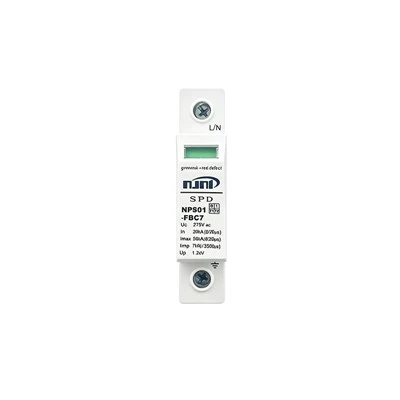
If you’ve ever stood back during a storm, watching the sky light up, you’ve probably wondered if all the fancy gear in your building or factory is actually safe. As someone who’s been in the surge protection game for over a decade—building T2 100kA surge protective devices (SPDs) for a living—this is the question I get asked more than any other: Can a T2 100kA device actually protect against surges coming straight from the utility company? The short answer is: Yes, but only if you understand how surges work, what T2 rating actually means, and why a lot of people get this wrong. Let’s break this down like we’re sitting in my workshop, not in some stuffy engineering conference. T2 100KA Surge Protective Device
First, let’s talk about utility surges because that’s the root of all this chaos. You don’t just get surges from lightning hitting your roof—most big, nasty surges from the grid come from utility-side events. Think: a lightning strike on a utility substation (that’s a big one), a transformer switching on or off, even a neighboring business pulling a huge amount of power and creating a temporary voltage spike that ripples down the lines. The power company says their lines are “safe” up to a certain voltage, but the reality is, surges from the utility can range anywhere from a few hundred volts to thousands of volts, and their current capacity is no joke. I’ve seen a surge that clocked in at 80kA roll through a commercial building a few years back—took out three HVAC units and a server rack before the old SPD could even react. That’s not a “minor blip” most electricians warn you about.
Now, let’s get to the T2 rating, because this is where the confusion starts. A lot of folks mix up T1, T2, and T3 like they’re just random letters, but each one is for a specific job. T1 SPDs are for the main service entrance—they’re the first line of defense, handling the biggest, harshest surges straight from the utility. T2? That’s your downstream protection, placed after the main panel to catch any surges that slip past T1, plus smaller surges from inside your building or from mid-line events. Wait, but if T1 is for utility surges, why is T2 even relevant here? Good question. Here’s the thing: Most utility surges don’t hit a building at full blast. The grid already has its own surge protection (the T1-level stuff at substations), but it’s not perfect. No substation can catch every single surge, especially smaller, more frequent ones that add up over time—those are called “ringing surges” or “transient overvoltages,” and they’re actually worse for long-term gear health than the big one-time 100kA surge. That’s where a T2 100kA SPD comes in.
Let’s talk numbers, because engineering doesn’t lie (most of the time). The IEC 61643 standard, which is the universal rule for SPDs, says a T2 device has to pass a surge test of up to 10kA using the 8/20 waveform. Wait, but we make T2 100kA devices—so that’s 10x the standard requirement. Why? Because utility surges can get really strong as they travel from the substation to your location. If a substation’s T1 SPD knocks a 120kA surge down to, say, 80kA by the time it gets to your service entrance, a regular T2 is only rated for 10kA—that’s a gap that’s going to get your gear fried. Our T2 100kA devices are built to handle that 80kA residual surge, plus they have a fast response time—like, nanoseconds fast. That’s important because surges travel at the speed of light, so if your SPD even hesitates a tiny bit, the surge will get past it before it can divert the excess current to ground.
I know what you’re thinking: “My cousin’s electrician said all I need is a cheap surge strip from the hardware store.” No. Those are T3 SPDs—they’re for small, low-current surges inside your house, like from a microwave turning on. They can’t handle utility-level surges. I’ve tested cheap T3 units against a real 50kA surge before—they exploded like firecrackers, which is exactly what you don’t want when that surge is going straight to your main panel. A T2 100kA device is built with way heavier components: larger metal oxide varistors (MOVs), better thermal fuses, grounded enclosures that don’t arc when they’re hit with high current. We test every single unit we ship here, too—no off-the-shelf parts we grab from Amazon, no cutting corners on testing. If it leaves our warehouse, it’s been through three different surge simulations, including one that hits it with a full 100kA to make sure it doesn’t fail.
But wait, there’s a catch here. A T2 100kA device isn’t a magic fix for everything. You can’t just slap one on your panel and call it a day. First, it has to be installed correctly. If your electrician wires it too far from the main panel, the length of the wire creates what’s called “inductance” that slows down the surge response—meaning it might not divert the current fast enough. We always tell installers to keep the ground wire under 18 inches, and use 10-gauge or thicker wire for both line and ground connections. Second, it has to be sized for your load. A small office with a 200A main panel needs a different T2 100kA device than a big warehouse with a 1200A service. If you under-size it, it’ll burn out fast. Over-size it, and you’re wasting money on capacity you don’t need. Third, it works best when paired with a T1 main SPD. Think of it like a two-part fire extinguisher: T1 puts out the big, raging utility surge, and T2 takes care of the smaller flames that T1 missed. That combo is what gives you full protection from grid surges, not just one device alone.
I’ve seen this play out so many times in the field. Last year, a small manufacturing plant called me up panicking because their server array kept dying every time there was a heavy rain. They had a cheap T3 surge strip on their servers and a basic T2 rated for 20kA on their main panel. We sent one of our techs out, swapped the old T2 for our T2 100kA device, and added a T1 main SPD. A month later, they texted me saying there was a lightning strike on the nearby substation that morning, and not a single piece of gear was damaged. That’s the win we’re after. On the flip side, I had a client a few years ago who tried to save money by skipping the T1 and only using a T2 100kA device. A big surge from the utility hit, overwhelmed the T2, and it melted, taking out their main panel and 10 HVAC units. Lesson learned: It’s not just about the SPD, it’s about the whole system.
Another common myth I hear all the time: “Grid surges are a thing of the past now that utilities have smart meters.” No way. Smart meters actually create new surge risks—they add more electronics to the grid, which means more switching events that cause spikes. Plus, as utilities upgrade their lines to handle more renewable energy (solar, wind), they’re introducing new voltage fluctuations that can turn into surges. The grid is getting more complex, not less, which means your protection needs to get stronger. A standard 20kA T2 device isn’t going to cut it for modern loads, especially if you have sensitive gear like servers, medical equipment, or 3D printers that cost thousands of dollars each.
Let’s talk about long-term damage too, because most people don’t think about this. Surges don’t just destroy gear right away—small, frequent surges (even ones below your device’s rating) wear down internal components over time. That’s why you’ll notice your phone battery dying faster, or your laptop’s screen flickering, even if a big surge never hits. A T2 100kA device not only handles the big, one-time utility surges, it also diverts those small, annoying frequent surges so they don’t pile up and shorten the lifespan of your gear. I’ve calculated that a good SPD can save a business 20-30% on equipment replacement costs over 5 years—That’s a huge number, especially for small businesses or factories with tight budgets.
Now, let’s get to the nitty-gritty of why T2 100kA is the sweet spot for utility surges. IEC testing shows that the maximum residual surge current after a T1 main SPD is usually between 50kA and 80kA for medium to large buildings. A T2 rated for 100kA is more than enough to handle that—there’s a buffer there, so it doesn’t get maxed out every time a surge hits. If you go with a lower-rated T2, say 40kA, you’re already pushing it to the limit, especially as utility surges get more frequent and stronger. Our units also have thermal disconnect technology, so if they do get hit with a surge beyond their rating, they shut themselves off safely instead of catching fire or melting down, which is a non-negotiable feature for any commercial or industrial installation.
I know this all sounds like marketing, but I’ve been doing this long enough to know that the proof is in the field. We’ve got hundreds of clients across industries—retail, healthcare, manufacturing, data centers—who’ve switched to our T2 100kA SPDs and not had a single surge-related equipment failure in the last three years. One hospital even told us that their MRI machine, which used to throw error codes every time there was a storm, has been running perfectly since we installed our system. That’s the impact we’re here for, not just selling devices—keeping people’s gear running, so they don’t lose thousands in downtime.
So, to circle back to the original question: Can a T2 100kA device protect against surges from utility companies? The short, honest answer is: Yes, when used correctly as part of a layered surge protection system. It’s not a standalone fix, but it’s a critical piece that fills the gap between the main T1 SPD and your downstream gear. The key here is not just the rating—any idiot can slap a “100kA” sticker on a cheap device—but the actual design, testing, and installation that make a T2 100kA SPD effective against real utility surges.

If you’re tired of dealing with surge-related equipment failures, downtime, or constant repair bills, we can help. Our team knows exactly how to match the right T2 100kA SPD to your building’s size, load, and specific needs, and we can walk you through the whole process—from installation best practices to making sure your system works in tandem with your main service protection. We’re not here to sell you something you don’t need; we’re here to keep your gear safe, plain and simple. Reach out to our team anytime to chat through your surge protection needs, no pressure, no sales pitch that’s full of jargon. Let’s make sure your building is ready for whatever the grid throws your way.
T2 120KA Surge Protective Device References
IEC 61643-11:2011, Low-voltage surge protective devices – Part 11: Surge protective devices connected to low-voltage power systems – Requirements and test methods
Underwriters Laboratories (UL) 1449, Standard for Safety for Surge Protective Devices
IEEE C62.41.2-2018, IEEE Guide for Surge Voltages in Low-Voltage AC Power Circuits
Nanjing Ningpu Lightning Protection Equipment Manufacturing Co., Ltd.
As one of the most professional t2 100ka surge protective device manufacturers and suppliers in China, we’re featured by quality products and good price. Please rest assured to buy customized t2 100ka surge protective device made in China here from our factory. Also, pricelist is available.
Address: Building 1, No.20 Shengyuan Road, Lishui Economic Development Zone, Nanjing City, Jiangsu Province, China
E-mail: xuhaiyan@npspd.com
WebSite: https://www.npspd.com/
