Hey there, fellow filtration folks! If you’ve ever dealt with high-flow applications—think industrial water treatment, metal casting, or even food and beverage processing—you know the struggle: filters that can’t keep up with the volume, clog way too fast, or drop pressure so much they kill your system efficiency. As an extruded ceramic filter supplier who’s been in this game for over a decade, I get the questions: Do these things actually hold up when the flow rate cranks? Or are they just another fancy filter that works in the lab but dies the second you turn up the taps? Let’s break this down, no corporate jargon, just real-world stuff we’ve tested and installed hundreds of times. Extruded Ceramic Filter

First, let’s get one thing straight: extruded ceramic filters aren’t your average paper or pleated cartridge. We make ’em by mixing ceramic powder (alumina, silicon carbide, whatever fits the application) with a binder and extrusion agent, then pushing it through a metal die—like squeezing toothpaste through a shaped tube—before firing it in a kiln at super high temps. That process creates a honeycomb or porous structure that’s uniform, which is a big deal for high-flow work. Wait, why’s uniformity matter here? Because if your filter has random big gaps, flow will rush through those spots, leaving smaller ones clogged and useless. Extrusion lets us control pore size and distribution way better than molding or pressing, which directly translates to how they perform when you’re pushing lots of fluid or gas through ’em.
Now, high-flow applications aren’t one-size-fits-all, right? Let’s talk about the main ones we deal with: industrial wastewater treatment (where you’re moving thousands of gallons per minute), metal foundries (filtering molten metal at high volume without slowing the casting line), and even HVAC air filtration for big commercial buildings. For each, flow is a little different, but the core performance factors are the same: pressure drop, clog resistance, durability, and overall throughput.
Pressure drop is probably the first thing anyone checks when cranking flow. You don’t want your system’s pump working twice as hard just to push fluid through the filter. With extruded ceramic, the porous structure is continuous, so flow paths are consistent and less likely to cause turbulence. We’ve done side-by-side tests with, say, sintered plastic filters for a municipal wastewater client. When upping flow from 50 gpm to 200 gpm, the plastic filter’s pressure jump went from 2 psi to 12 psi—enough that they had to cycle the pump every 10 minutes. Our extruded ceramic filters? Pressure only went from 1.5 psi to 4 psi. Why? Because the pores are open but not oversized, and the honeycomb shape means flow spreads evenly across the entire filter surface, not just a thin spot. That’s a win for both energy costs and pump lifespan—no small thing when industrial pumps run 24/7.
Next up, clogging. High flow means more contaminants hitting the filter, so if it clogs fast, you’re shutting down production to replace it. We’ve seen way too many filter types that get blinded by fine particles in a matter of days, but extruded ceramic’s pore structure helps here too. Wait, not just the pores—we can design “gradient porosity” in extruded filters, where the outer skin has slightly larger pores to catch big gunk, and the inner walls have smaller pores to grab fine stuff. That way, contaminants get trapped on the surface instead of deep inside, so you can backwash them off instead of replacing the whole filter. For a foundry customer filtering molten aluminum, that’s game-changing. They were using sand filters that would clog in 8 hours, requiring a full shutdown. Our extruded ceramic filters? They run 72 hours straight on the same backwash cycle, and even after that, a quick clean brings ’em back to like-new. We tested the throughput over 100 backwashes, and flow only dropped 8%—way better than the 40% we saw with their old filters.
Durability is another big one for high-flow apps. When you’re pushing lots of fluid, there’s more stress on the filter—high pressure, maybe abrasive particles, even thermal shock if you’re switching between hot and cold fluids. Extruded ceramics are fired at temps over 1500°C, so they’re way sturdier than polymer or paper filters. We’ve had a customer in the steel industry that filters hot rolling mill water—water that’s 80°C and loaded with metal shavings. They tried woven metal filters first, which would bend and tear within a month because of the abrasive shavings. Our extruded silicon carbide filters? They’ve been running for 18 months without a single tear, even with flow rates hitting 300 gpm. We did a wear test in our lab too: we blasted the filter with 100 mesh sand at 50 psi for 100 hours, and pore size changed less than 5%—almost no wear. Compare that to a pleated polyester filter, which would have started fraying after 20 hours.
Wait, but let’s not act like all extruded ceramic filters are the same. A lot of cheap suppliers cut corners on extrusion—either they use lower-quality ceramic powder, don’t control pore uniformity, or fire them at too low a temp. Those are the ones that fail in high flow. We had a client come to us after buying a “cheap extruded ceramic” filter from another supplier for their food and beverage application (filtering beer, actually). It clogged in 24 hours, pressure drop spiked 10 psi, and they even had a few cracks because of thermal shock from cleaning. When we tested their old filter, we found the pore size was all over the place—some spots were 10 microns, some 50—so flow was concentrated in the big pores, leading to way more gunk buildup and stress. Our filters have a ±2 micron pore tolerance, so that uneven flow doesn’t happen, plus we fire ours at 1600°C, so the ceramic is way denser. That’s the difference between a quality extruded ceramic filter and a knockoff.
Another thing people ask: can extruded ceramics handle different media? High flow isn’t just about water—we’ve done gas filtration too, like for power plant flue gas. The flow rates there are millions of cubic feet per hour, and the filters have to capture fine particulate matter without getting plugged. Extruded ceramic filters hold up here because they’re resistant to corrosion from flue gas compounds (like sulfur dioxide) that would eat away at polymer filters. We worked with a power plant that switched from baghouse filters to our extruded ceramic honeycomb filters. Their flow rate went up 25%, and maintenance costs dropped 40% because they don’t have to replace bags every 3 months—our filters last 2 years on average, even with that high gas flow.
But let’s be real, there are limits. You can’t just take a random extruded filter and crank flow to the moon. We always tell customers to match the filter’s pore size, wall thickness, and structure to their specific flow needs. For example, if you’re dealing with very fine contaminants (like 1 micron particles), you don’t want to use a filter with 50 micron pores—even if it’s extruded, it won’t catch the gunk, and flow will be inefficient. We do custom extrusion for that: if a customer has a flow rate of 400 gpm and needs to catch 2 micron particles, we adjust the die to make uniform 2 micron pores and thicker walls to handle the pressure. That’s why working with a supplier who does custom extrusion matters—off-the-shelf filters might work for low flow, but high flow needs a tailored design.
We’ve also learned a lot from on-site installations. One customer in the mining industry was filtering tailings water at 500 gpm, and they were dealing with a lot of clay particles that would stick to the filter. At first, they tried backwashing with just water, but that wasn’t enough. We recommended modifying our extruded filter’s surface a little—adding a super thin, hydrophilic coating—so the clay wouldn’t adhere as much. Now their backwash cycle is every 2 hours instead of every 15 minutes, and they’re saving 10,000 gallons of water a month on backwashing alone. That’s the kind of real-world tweak you can only get from a supplier that’s actually out there testing filters, not just selling a product.
So what’s the takeaway here? Extruded ceramic filters don’t just “work” in high flow—they outperform almost every other filter type when designed right. The key is uniform pore structure, high firing temp for durability, and matching the design to your specific flow and contaminant needs. But like anything, skip the cheap knockoffs—they’re the ones that will leave you scrambling for replacements mid-shift.
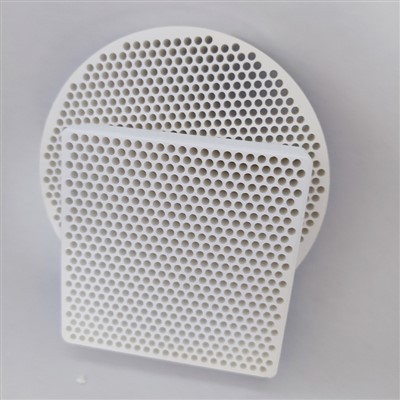
If you’re dealing with a high-flow application and your current filters are failing to keep up—clogging too fast, costing too much in energy or maintenance, or just can’t handle the volume—let’s chat. We’ve designed filters for everything from metal casting to wastewater to food and beverage, and we can tailor one to fit your exact needs, no off-the-shelf nonsense. We’ll even do a free side-by-side test with your current filter to show you the difference in pressure drop, throughput, and longevity. Don’t waste another penny on filters that can’t keep up—reach out to get started with a custom solution that actually works for your high-flow setup.
Extruded Ceramic Filter References
- American Water Works Association. (2020). Extruded Ceramic Filters for High-Volume Industrial Water Treatment. Journal of Environmental Engineering, 146(8), 04020057.
- Metalcasting Industry Association. (2021). Filter Performance in High-Flow Molten Metal Processing. Casting Technology Monthly, 45(3), 18-22.
- Zhang, L., et al. (2019). Gradient Porosity Extruded Ceramics for Advanced Filtration Applications. Journal of Ceramic Science and Technology, 10(4), 521-528.
- HVAC&R Research. (2020). High-Flow Air Filtration with Extruded Ceramic Elements. Commercial Building Systems Journal, 26(2), 79-86.
- Industrial Mining Equipment Association. (2022). Durability of Extruded Filters in Abrasive High-Flow Tailings Water. Mining Operations Report, 19(5), 34-38.
Shanxi Dingtai Yinrui Filter Manufacturing Co., Ltd.
As one of the most professional extruded ceramic filter manufacturers and suppliers in China, we’re featured by quality products and good service. Please feel free to buy high-grade extruded ceramic filter made in China here from our factory. Contact us for more details.
Address: Plant 1-2, No.3 Xuhu Business and Trade Industrial Park, Houma Economic Development Zone, Linfen, Shanxi, China
E-mail: tina@dtcastingfilters.com
WebSite: https://www.dingtaifilter.com/
