Selecting the right canister compression load cell for a specific application is a critical decision that can significantly impact the accuracy, reliability, and overall performance of your weighing or force measurement system. As a supplier of canister compression load cells, I understand the importance of this choice and am here to guide you through the process. Canister Compression Load Cells
Understanding Canister Compression Load Cells
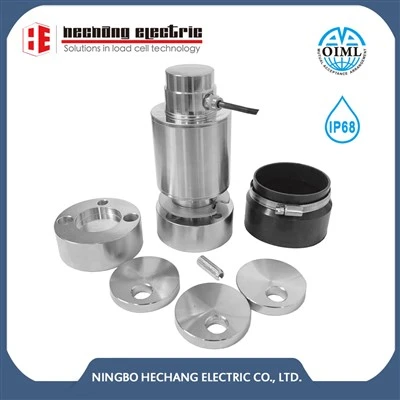
Canister compression load cells are designed to measure forces applied in a vertical or compressive direction. They are widely used in various industries, including automotive, manufacturing, aerospace, and more. These load cells are known for their high accuracy, robustness, and ability to withstand harsh environments.
The basic principle behind a canister compression load cell involves the deformation of a spring element when a force is applied. This deformation is then converted into an electrical signal proportional to the applied force. The most common type of canister compression load cell uses strain gauges, which are bonded to the spring element. When the spring element deforms, the strain gauges change their resistance, and this change is measured and converted into a force reading.
Factors to Consider When Selecting a Canister Compression Load Cell
1. Capacity
The first and most crucial factor to consider is the load capacity required for your application. This is the maximum force that the load cell needs to measure accurately. Selecting a load cell with a capacity that is too low can lead to overloading and damage to the load cell, while choosing one with a capacity that is too high can result in reduced accuracy.
To determine the appropriate capacity, analyze the maximum and minimum forces that your application will experience. Consider any dynamic forces, such as shock or vibration, that could be present during operation. It’s also a good idea to add a safety factor of around 10 – 20% to account for unexpected loads.
2. Accuracy
Accuracy is another vital factor when selecting a canister compression load cell. Accuracy is typically expressed as a percentage of the full-scale output (FSO) of the load cell. For example, a load cell with an accuracy of ±0.1% FSO means that the measured value can deviate by up to 0.1% of the maximum capacity of the load cell.
The required accuracy depends on the specific application. In applications where high precision is essential, such as in scientific research or calibration laboratories, a load cell with a high accuracy rating is necessary. On the other hand, for less critical applications, such as general industrial weighing, a lower accuracy load cell may be sufficient.
3. Environmental Conditions
The environmental conditions in which the load cell will operate play a significant role in its selection. Factors such as temperature, humidity, dust, and vibration can all affect the performance and lifespan of the load cell.
- Temperature: Extreme temperatures can cause the materials in the load cell to expand or contract, which can affect the accuracy of the measurement. Some load cells are designed to operate over a wide temperature range, while others may require temperature compensation.
- Humidity and Dust: High humidity or dusty environments can cause corrosion and damage to the load cell. Look for load cells that are sealed and have a high IP (Ingress Protection) rating to protect against moisture and dust.
- Vibration: Vibration can introduce noise and errors into the measurement. Load cells with good vibration resistance or built – in dampening features are ideal for applications where vibration is present.
4. Output Signal
The output signal of the load cell is also an important consideration. The most common output signals for canister compression load cells are millivolts per volt (mV/V) and current (4 – 20 mA) or voltage (0 – 10 V).
- mV/V: This is the most basic output signal and requires a signal conditioner to convert it into a usable measurement. It is suitable for applications where the load cell is close to the measuring instrument.
- 4 – 20 mA or 0 – 10 V: These output signals are more convenient as they can be directly connected to data acquisition systems or controllers. They are also more resistant to noise and interference, making them ideal for long – distance transmission.
5. Mounting and Installation
The mounting and installation requirements of the load cell should also be considered. Canister compression load cells can be mounted in different ways, such as using bolts, flanges, or clevises. Make sure that the load cell can be easily installed in your application and that the mounting method will not introduce any additional stresses or errors into the measurement.
6. Compatibility
Ensure that the load cell is compatible with your existing weighing or force measurement system. This includes compatibility with the signal conditioner, display unit, and any other components in the system. If you are upgrading an existing system, it’s important to check whether the new load cell can be integrated without significant modifications.
Application – Specific Considerations
Different applications have different requirements for canister compression load cells. Here are some examples of common applications and the specific factors to consider:
1. Industrial Weighing
In industrial weighing applications, such as weighing hoppers, tanks, or conveyor belts, high accuracy and reliability are essential. The load cell should be able to withstand the continuous loading and unloading cycles and the harsh industrial environment. A high – capacity load cell with good shock and vibration resistance is typically required.
2. Automotive Testing
In automotive testing, such as measuring the forces on suspension systems or brakes, the load cell needs to have a high frequency response to accurately measure dynamic forces. It should also be able to withstand the high – speed and high – force conditions present in automotive testing.
3. Aerospace Applications
Aerospace applications require load cells that are lightweight, compact, and can operate in extreme temperatures and pressures. High accuracy and reliability are of utmost importance, as any measurement error can have serious consequences.
Choosing the Right Supplier
Selecting the right supplier for your canister compression load cell is just as important as choosing the right load cell itself. A reliable supplier can provide you with high – quality products, technical support, and after – sales service.
- Quality Assurance: Look for a supplier that has a rigorous quality control system in place. This ensures that the load cells meet the required standards and specifications.
- Technical Expertise: A supplier with a team of experienced engineers can provide you with valuable advice on load cell selection, installation, and calibration.
- Customer Support: Good customer support is essential, especially if you encounter any issues with the load cell. A supplier that offers prompt and reliable customer support can help you resolve problems quickly.
Conclusion
Selecting the right canister compression load cell for a specific application requires careful consideration of several factors, including capacity, accuracy, environmental conditions, output signal, mounting requirements, and compatibility. By understanding these factors and working with a reliable supplier, you can ensure that you choose the load cell that best meets your needs.
Canister Compression Load Cells If you are in the process of selecting a canister compression load cell for your application, I invite you to contact us for professional advice and assistance. Our team of experts is ready to help you find the perfect load cell solution for your specific requirements.
References
- "Load Cell Handbook" – A comprehensive guide to load cell technology and applications.
- Industry standards and specifications related to load cells, such as ISO and ASTM standards.
Ningbo Hechang Electric Co., Ltd.
As one of the most professional canister compression load cells manufacturers and suppliers in China, we also support customized service. We warmly welcome you to buy advanced canister compression load cells for sale here from our factory. If you have any enquiry about cooperation, please feel free to email us.
Address: No.66 Yongmao West Road, Ningbo, China
E-mail: info@hcesensor.com
WebSite: https://www.hechangsensor.com/
